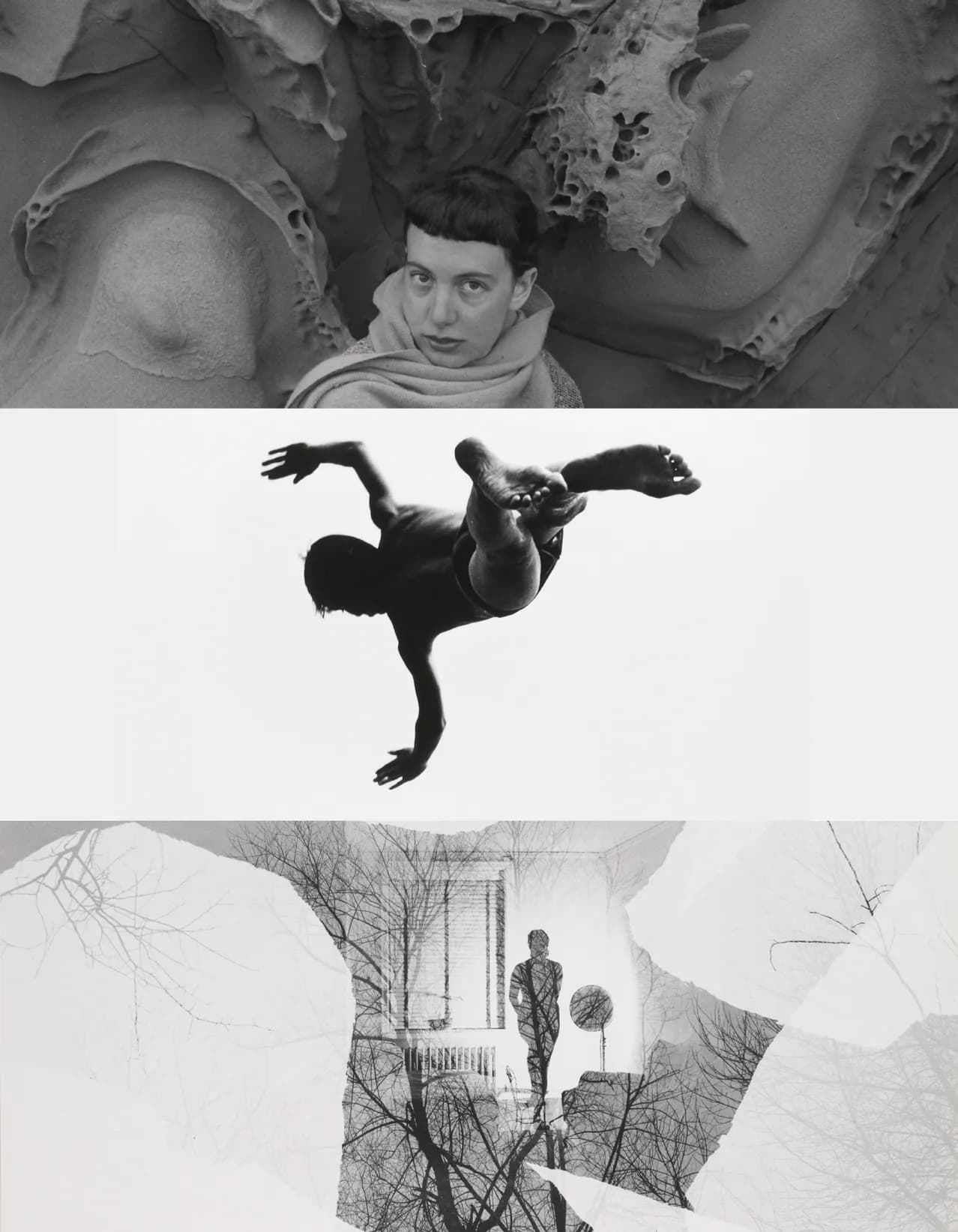
Photography as a Way of Life: Minor White, Aaron Siskind, and Harry Callahan
Minor White (1908-1976) was an influential American photographer, teacher, and critic whose work profoundly shaped mid-20th-century photography. Born in Minneapolis, Minnesota, he initially pursued poetry and psychical research before discovering photography in the 1930s. His early career included documenting rural America during the Great Depression for the Farm Security Administration, where he honed a documentary style infused with personal symbolism. White's photographs often transcended literal representation, exploring themes of equivalence—where images evoked emotional and spiritual resonances akin to music or poetry. His iconic series, such as those from Point Lobos State Reserve, captured natural forms with meticulous detail and abstract intensity, blurring the line between landscape and metaphor.[artist knowledge]
All exhibitions →Aaron Siskind emerged as a pivotal figure in mid-20th-century photography, transitioning from documentary work to abstract expressionism that elevated the medium to fine art. Born in 1903 in New York City to Russian Jewish immigrant parents, he initially pursued social realism, capturing street life and Harlem communities during the 1930s as part of the New York Federal Art Project's Photo League. His early images, marked by a compassionate eye for human struggle, evolved dramatically after encountering the monumental abstractions of Franz Kline in the 1940s. Siskind began photographing urban walls, weathered signs, and natural textures—blistered paint, cracked surfaces, and organic forms that mimicked the gestural freedom of action painting. These works, with their dramatic close-ups and emphasis on texture over narrative, positioned photography as a peer to Abstract Expressionism, influencing contemporaries like Willem de Kooning. Siskind's tenure at the Institute of Design in Chicago from 1951 onward solidified his legacy as an educator and innovator. There, alongside Harry Callahan, he shaped a generation of photographers by advocating for photography's equivalence to poetry and painting, where form and emotion superseded literal representation. His series such as 'The Constant World' and 'Louisiana' series transformed detritus into sublime compositions, with billowing tar paper or dripping graffiti evoking primordial forces. Later, collaborations with dancers and explorations of underwater forms expanded his visual lexicon, always probing the boundary between representation and pure visual rhythm. Siskind's philosophy, articulated in essays like 'The Drama of Objects,' championed the camera's ability to reveal hidden dramas in the everyday, making the mundane monumental. Throughout his career, Siskind bridged worlds—social documentary, abstraction, and pedagogy—leaving an indelible mark on American photography. His influence persists in contemporary artists who mine urban decay for emotional depth, affirming his role as a bridge between photography's past and its abstract future. Exhibitions worldwide, including retrospectives at the Museum of Modern Art, underscore his enduring impact on how we perceive the photographic image as both document and metaphor.
All exhibitions →Harry Callahan, born in 1912 in Detroit, Michigan, rose from humble beginnings as a self-taught photographer to become a master of modernist experimentation, renowned for his poetic integration of urban landscapes, abstraction, and personal motifs. Working as a clerk at a camera shop in the 1930s, he discovered Ansel Adams' work, igniting a lifelong passion. His pivotal encounter with László Moholy-Nagy in 1941 led to his appointment at the Institute of Design in Chicago, where he taught alongside Aaron Siskind, developing a curriculum that emphasized photography as a creative equivalent to music and poetry—prioritizing intuition, multiple exposures, and technical innovation over strict realism. Callahan's oeuvre is characterized by intimate portraits of his wife Eleanor, often nude amidst natural elements like snow, weeds, or water, rendered through double exposures and high-contrast printing that blur figure and ground into dreamlike harmonies. His Chicago street scenes, with pedestrians dissolving into architectural geometries or fog-shrouded high-rises, capture the city's pulse through rhythmic compositions and tonal subtlety. Innovations like infrared film, pin-hole cameras, and color work pushed technical boundaries, transforming everyday scenes—Providence trees, aerial views, shadows—into studies of light's ephemerality and form's universality. These works eschew sentimentality for a quiet, meditative formalism that reveals profound beauty in transience. Retiring from teaching in 1977, Callahan continued exploring until his death in 1999, with major retrospectives at institutions like the Museum of Modern Art affirming his stature. His influence endures in photographers who embrace experimentation and personal vision, proving that photography's power lies in its capacity to distill life's complexity into elegant, evocative simplicity. Callahan's legacy as both artist and educator reshaped the medium, inspiring generations to see the world through a lens of wonder and precision.
All exhibitions →This exhibition examines the influential careers of Minor White, Aaron Siskind, and Harry Callahan, highlighting their impact on mid-twentieth century photography.