Shawn Theodore at NXTHVN: Glory
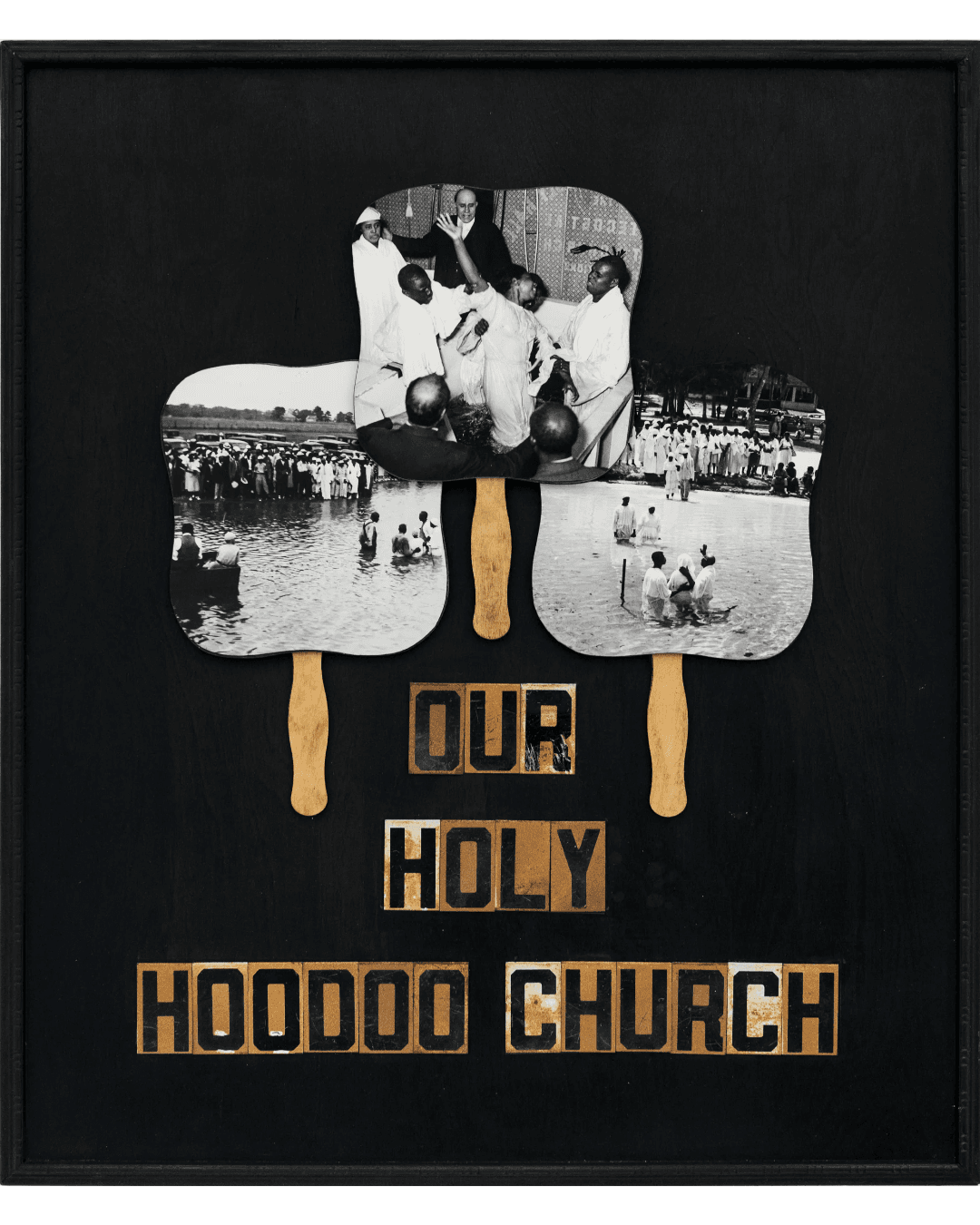
Shawn Theodore is a conceptual photographer and mixed media artist whose work deeply engages with the reimagination of Black historical narratives and spiritual legacies. Rooted in single-person portraiture, his practice evolves beyond traditional photography to encompass acrylic painting, collage, and assemblage, transforming everyday objects into profound symbols of cultural memory. In his Afromythology™ series, Theodore draws inspiration from familial artifacts like church fans, photo albums, and wooden chess sets, weaving them into narratives that connect ancestors, divine figures, and contemporary Black identity. Works such as 'Bus Stop — Oshun, Elegba, Oya, Papa Legba on the way,' an acrylic and collage on panel, exemplify his ability to fuse vibrant colors and layered compositions that evoke the sacred within the mundane. Theodore's contributions to exhibitions like 'A Race of Angels' at Paradigm Gallery + Studio highlight his exploration of Black figuration through reclaimed photographs and familial roots, particularly resonant in his Philadelphia origins. This solo show, his second with the gallery, marked a bold departure from photographic norms, inviting viewers to reconsider divine connections in family histories. In the group exhibition 'Glory' at NXTHVN, Theodore's pieces align with themes of memory, domesticity, and 1970s Black American home aesthetics, positioning the interior as a subconscious archive. His art transforms personal and collective trauma into spaces of joy and pride, using materiality to narrate resilience and beauty amid societal challenges. Through these bodies of work, Theodore not only documents but actively reconstructs Black cultural narratives, making the invisible visible and the ordinary extraordinary. His interdisciplinary approach bridges photography's precision with painting's expressiveness and collage's tactility, creating immersive worlds that honor survival, community, and spiritual continuity. As an artist firmly embedded in Philadelphia's creative ecosystem, Theodore continues to influence dialogues on identity, ensuring his voice echoes in both local galleries and broader contemporary discourse.
All exhibitions →Faustin Adeniran is a Nigerian-born contemporary artist whose practice emerges from a profound commitment to material reclamation and social commentary. Based in the United States after emigrating from Lagos, Adeniran works primarily with discarded and recyclable materials—aluminum cans, scrap metal, paper, and found objects—transforming them into compelling visual narratives that challenge viewers to reconsider waste and its relationship to human value. His artistic vision was shaped early; he recalls drawing on the walls of his childhood home at age five and committing to an artistic life by ten years old. Faced with the prohibitive cost of traditional art supplies as a young artist in Nigeria, he developed an innovative approach using accessible materials like colored sand, which he would pour meticulously to create finely detailed portraits. His technical skill was so extraordinary that observers believed he must be employing some form of spiritual intervention or mechanical assistance. This resourcefulness became not merely a practical solution but the philosophical foundation of his entire artistic practice. Adeniran's distinctive visual language centers on the dialogue between materials and meaning, where every choice of medium functions as a direct commentary on environmental justice, cultural identity, and the lives of marginalized communities. His celebrated Discarded and Society Series works transform aluminum cans into haunting portraits of Black Americans, honoring those lost to systemic injustice while simultaneously critiquing consumer culture and environmental destruction. His practice is deeply informed by his experience as an immigrant and world traveler, perspectives that lend his work a nuanced understanding of how different communities navigate global systems of production and waste. Beyond static artworks, Adeniran collaborates on participatory projects that invite communities into the creative process itself, as demonstrated in his work with Yale medical residents where personal objects were woven together into a communal mosaic titled "The Healers," exploring the parallels between artistic creation and the healing professions. His material choices deliberately reflect the communities where he works, ensuring that his art speaks directly to local experiences while addressing universal themes of resilience and dignity. For Philadelphia audiences encountering Adeniran's work, his practice offers a powerful counternarrative to narratives of disposability that too often extend from objects to people themselves. In the context of Glory and NXTHVN's reimagining of the Black American home as an archive of joy and resilience, Adeniran's transformation of cast-off materials into monuments of beauty and remembrance provides a visual language for celebrating what dominant culture deems worthless. His work insists that the materials surrounding us—the cans we discard, the metals we overlook—contain within them stories of care, labor, and survival worthy of artistic grandeur. Through his mixed media practice, Adeniran invites viewers into what he describes as a journey of material consciousness, asking profound questions about what we value and what we throw away, making his contribution to this exhibition a meditation on the radical act of honoring Black life through meticulous artistic attention and reclaimed materials.
All exhibitions →Akea Brionne, born in 1996 in New Orleans and raised in Baltimore, is an interdisciplinary artist and researcher now based in Metro Detroit, where she maintains a dynamic studio practice at the nexus of lens-based and fiber-based media. With a dual BA/BFA in photography and humanistic studies from the Maryland Institute College of Art, followed by an MFA in photography from Cranbrook Academy of Art as a Gilbert Fellow, Brionne's work spans photography, textiles, mixed media, and emerging technologies like artificial intelligence and digital weaving. Her style fuses surreal, dreamlike compositions with glittering embellishments—sequins, rhinestones, and bold patterns—exploring core themes of colonial and imperialist histories' lingering echoes in identity politics, cultural storytelling, assimilation, and the African Diaspora, particularly Afro-Creole traditions. Represented by Library Street Collective in Detroit and Lyles & King in New York, she transforms personal and collective narratives into multidimensional tapestries that challenge viewers to reconsider agency, subjecthood, and interiority through experimental craft. What distinguishes Brionne's oeuvre is her innovative "lens-based textile" approach, where photography serves as the foundational layer: self-portraits and found imagery are collaged via AI into otherworldly seascapes featuring poised women in oversized sunglasses and cinched dresses amid African masks, De Chirico-inspired architecture, and fractured Cubist forms. This visual language draws from family lore, radical imagination, and oral storytelling, evoking an Afro-Surrealist realm where past and future collide, subverting art historical canons tied to colonial exclusion. Influenced by her roots in Creole culture and migrations across the Americas, her pieces interrogate survival through assimilation, social geography, and the performance of Black identity, rendering photography tactile and immersive beyond the flat print—qualities that earned her a solo debut at Cranbrook Art Museum's Fresh Paint series. In the immersive group exhibition "Glory" at NXTHVN, curated by 2025-2026 fellows Tara Fay Coleman and Juanita Sunday, Brionne's mixed-media contributions—blending painting, photography, and fiber elements—form a radiant thread reimagining the Black American home as an archive of joy, memory, and resilience. Philadelphia audiences will encounter her glittering tapestries and installations as vibrant portals into Afro-Creole dreamscapes, their surreal shimmer and historical depth inviting intimate reflections on diaspora legacies amid the show's architectural dialogues. Opening March 7, her work at Paradigm Gallery + Studio promises a Philly debut that electrifies the space, urging visitors to dwell in the multidimensional interplay of personal reverie and collective endurance.
All exhibitions →Shawn Theodore's contribution to Glory at NXTHVN forms a vital thread in this immersive group exhibition, curated by 2025-2026 fellows Tara Fay Coleman and Juanita Sunday, which reimagines the Black American home as a radiant archive of joy, memory, and resilience. Opening…